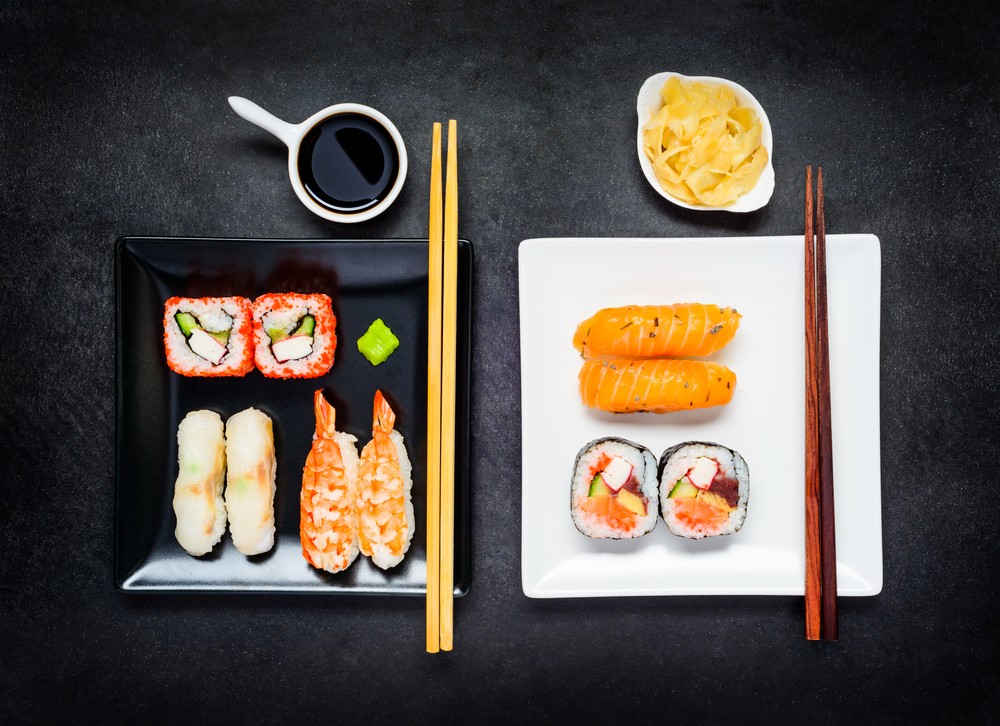
The aesthetic component is in the Traditional Japanese cuisine fundamental element on par with the balance of flavors, combination of ingredients and cooking. The dishes of the Washoku are dishes that should be admired before being tasted, and the whole Japanese culinary tradition is based on outward appearance, which has an important function of spiritual nourishment.
Beauty, order, and harmony are concepts that before anything else are learned when one approaches this type of cooking and learns the noble art of plating.
The hassun tray.
Used in theimpiattamento in Japanese Cuisine è the hassun, an elegant and refined square-shaped tray, which also manages to hold a number of servings equal to the number of diners. On it, the dishes are arranged in such a way as to constitute a kind of visual spectacle from any vantage point viewing it.
The theory of the five elements in Japanese cuisine.
The hassun is made of Japanese cedar and on it the courses of the meal are arranged following a principle borrowed from Chinese culture: that of the Ying-Yang and Of the five elements.
According to this theory, there are five flavors: sweet, sour, spicy, bitter, salty. And five are the colors: red, green, yellow, black, white and as many are the cooking methods: barbecuing, boiling, frying, steaming, raw. It is also related to the five senses: sight, hearing, touch, taste and smell.
A plate of Japanese cuisine can be said to be complete when taste, color and cooking method are in harmony and there is no predominance of any one of these elements.
Plating.
If the greatest difference between the western cuisine and that Japanese è in implantation, it is well understood how this aspect plays a key role.
One of the main arrangements of dishes is the triangular arrangement of dishes, which interprets stability, balance. A balance that can also be achieved through reasoned asymmetry.
Important is the balance of foods and color, chromatic harmony, the visual stimulus.