In the Middle Ages, and later until the 1800s, the United Kingdom had a high concentration of lamprey, a river fish that was highly prized in ancient times. It is said that Henry I himself, who ruled England until 1135, was particularly fond of it, so much so that it even cost him his death.
In fact, history records how the king died, during a hunting trip in Normandy, from lamprey poisoning. To this day, this product is still remembered as "the fish that killed the king."
And so it is that English history is reflected in Italian and, in particular, Florentine history.
The 'Arno, in fact, until the last century was rich in a very delicious freshwater fish, which was consumed during the Renaissance by the wealthiest Florentines. It was called, in fact, lamprey.
The commoners, however, could not afford to consume it and did not have access to even the finest meats. They had to make do with consuming, therefore, the waste products of the meat that was slaughtered; many of these parts were boiled and then sold cheaply at stalls set up along the banks of the Arno.
In this way, it was possible to consume high-protein meals but with minimal expense. So it was that this food made from animal waste was named, with a hint of irony, Lampredotto, because it retained in appearance, when cooked, a resemblance to the flesh of freshwater fish.
From then on, the lampredotto has become part of the Tuscan culinary tradition, becoming the undisputed king of the Florentine street-food.
If one thinks of Florence from a culinary perspective, in fact, one of the dishes that immediately springs to mind is the famous Lampredotto Sandwich!
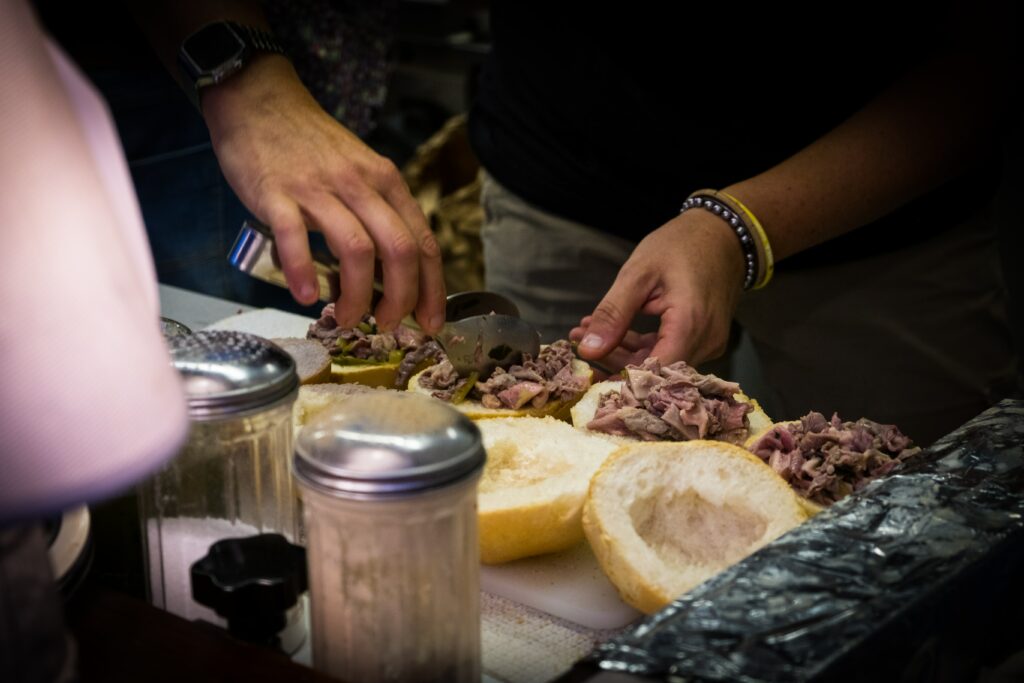
Served on stalls in the alleys and squares of Florence, a poor and intoxicating street food: it is he, the famous lampredotto sandwich, a soft and fragrant tripe - to use it you use the abomasum (one of the four stomachs of the cattle) - lying in a crumbly rosetta or michetta (also called, in the Tuscan capital, semella or passerina), which stands, precisely, as one of the most authentic and characteristic culinary treasures of Tuscan cuisine.
Eating lampredotto is much more than a simple culinary experience: is a real social ritual for Tuscans. In Florence, you can find the famous lampredotto stands scattered around the city, where people gather to enjoy this delicacy for lunch or dinner. Tasting the lampredotto sandwich is now an ingrained tradition in the daily life of Florentines as well as, clearly, a must for tourists who join this convivial meal to experience The authenticity of local cuisine.
The preparation of lampredotto is a process that requires patience and skill: after being thoroughly cleaned, the bovine stomach is cooked in a broth rich in herbs and spices. Slow cooking allows the tripe to reach a soft and succulent texture, so that it can be poi thinly sliced and topped with a tasty sauce. Once prepared, lampredotto can be served in a variety of ways: inside a sandwich enriched with a green sauce made from parsley, garlic, capers and anchovies, or as part of a complete meal with the addition of hot sauce.
And therein lies the beauty: a special condiment that makes this sandwich even more special. Each Florentine, in fact, has his or her own secret to make it irresistible and unique.
Whatever dressing you choose, however, the advice is to accompany it with good chianti or a cool drink, such as a florentine craft beer.
Enjoy your meal!